When Stripe, Visa, and the SEC All Moved in the Same Week: The Quiet Revolution in Machine Money
The Week Everything Changed
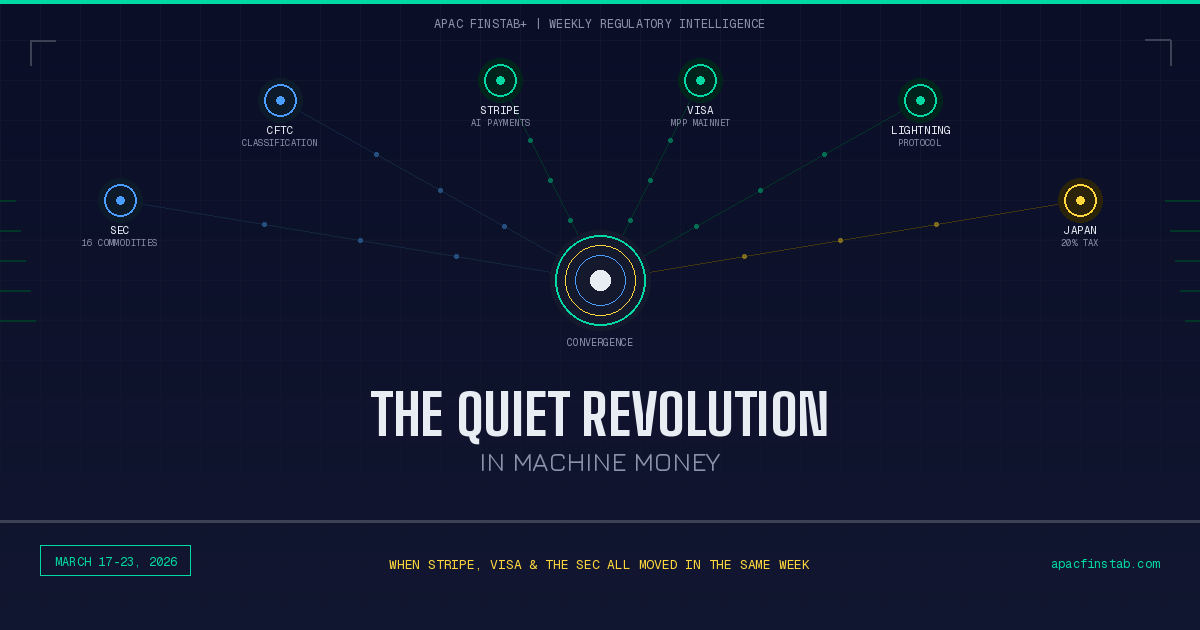
On Monday, March 17th, the SEC and CFTC jointly classified 16 digital assets as commodities. By Wednesday, Stripe, Visa, and Lightning Labs launched a payment network designed not for humans, but for AI agents. On Friday, Japan slashed its crypto tax rate from 55% to 20%.
Any one of these events would have been significant. Together, they represent something more fundamental: the infrastructure for a new financial system is being built in plain sight, and the builders aren't crypto startups anymore.
They're the companies that already move your money.
The Commodities Decision Nobody Noticed
The SEC and CFTC joint classification of 16 assets as digital commodities was buried in Friday news cycles. It shouldn't have been.
For years, the fundamental question hanging over crypto has been simple: are these things securities or commodities? Securities require registration, disclosure, and a web of compliance obligations. Commodities trade freely.
With one announcement, that question was answered for ADA, XRP, SOL, LINK, DOGE, SHIB, and ten others. Perhaps more interestingly, WIF — a meme coin featuring a dog in a hat — was classified as a "digital collectible," creating an entirely new regulatory category.
What this actually means: Institutional investors who couldn't touch these assets for compliance reasons now can. The ETF filing pipeline, already crowded, is about to get more so. And the 70% of top-30 tokens that just received commodity status? Their path to traditional financial products just cleared.
But this was only Monday.
The Payment Network That Doesn't Need You
On Wednesday, something stranger happened.
Stripe, Visa, Tempo, and Lightning Labs launched the Machine Payments Protocol — MPP — on mainnet. This isn't a payment system for consumers. It's not even primarily for businesses.
It's a payment rail designed for AI agents to pay each other.
Consider what this means. When you use Uber, you pay for a ride. But increasingly, what's actually happening is that an AI system is dispatching a driver, routing the vehicle, calculating the fare, and processing the payment. The human parts of this transaction — you deciding to hail a ride, you tapping your phone — are becoming smaller and smaller portions of the overall process.
MPP is infrastructure for what happens when those human parts disappear entirely.
An AI agent managing a supply chain could automatically pay for warehouse space. A trading algorithm could compensate an oracle service for real-time data. An autonomous content system could license images, pay for compute, and distribute revenue — all without human approval for individual transactions.
The compliance problem nobody has solved: There is no regulatory framework anywhere in the world for AI-to-AI payments. Zero jurisdictions have issued guidance on:
- Who is responsible when a machine makes a payment?
- How do you KYC an AI agent?
- What happens when autonomous systems transact across borders?
- Who do you sue when an AI's payment causes harm?
Stripe and Visa launched this anyway. That tells you something about how fast things are moving.
Japan's Quiet Earthquake
Then there's Japan.
For years, Japan has been a peculiar outlier in crypto: enthusiastic early adoption, strict regulatory oversight, and punishing tax rates. Crypto gains were taxed as miscellaneous income at rates up to 55% — making Japan one of the most expensive places in the world to hold crypto profitably.
That changed this week. Japan cut its crypto tax rate to a flat 20%.
This single decision makes Japan competitive with Singapore and Hong Kong for crypto-native wealth. For a region where capital moves easily between financial centers, this is significant.
The capital migration question: South Korea taxes crypto at 22%. India at 30%. Where does money flow when one major economy suddenly becomes 35 percentage points cheaper?
Watch the exchange deposit data over the next quarter. The flows will tell the story.
The Tether Signal Everyone Missed
While the world focused on MPP and SEC classifications, Tether did something that received almost no attention.
Over the past 30 days, Tether has deployed $20 million into Bitcoin layer-1 infrastructure. They're co-leading development of the RGB protocol. They're building UTXO infrastructure. They're working on Ark Labs. They integrated USDT natively into the Lightning Network.
This isn't a small investment for a company of Tether's scale. It's a signal.
What Tether sees: The largest stablecoin issuer in the world is betting that Bitcoin — not Ethereum, not Tron, not any L2 — will be the settlement layer for digital dollars by 2027.
If they're right, the entire stablecoin infrastructure map redraws. If they're wrong, they've spent $20 million on an interesting experiment. Given Tether's history of being early to trends that later became dominant, the bet deserves attention.
The Vulnerability That Won't Die
Not everything this week was progress.
Venus Protocol, a DeFi lending platform, lost $2.15 million to an oracle manipulation attack. This would be unremarkable except for one detail: this was the second time the exact same vulnerability was exploited in under two years.
The attacker deposited 84% of THE token's circulating supply as collateral. The protocol had no concentration limits. The oracle was manipulated. Money was extracted.
The same thing happened before. Nothing was fixed.
What this reveals about DeFi: Markets are willing to price in "they'll eventually fix it" rather than "they actually fixed it." Venus's token didn't crash. Users didn't flee. The protocol absorbed the loss and continued operating.
This is either remarkable resilience or remarkable complacency. The next exploit will tell us which.
What Comes Next
The events of March 17-23 don't resolve into a simple narrative. They're not uniformly bullish or bearish. They're not about one technology winning or losing.
What they reveal is a financial system in active transformation.
The SEC is providing clarity. Traditional payment companies are building AI-native infrastructure. Major economies are competing for crypto capital through tax policy. The largest stablecoin issuer is betting on Bitcoin. And DeFi protocols are demonstrating both their potential and their persistent governance failures.
For institutional observers, the compliance implications are immediate:
- Asset classification matrices need updating
- AI payment infrastructure requires new risk frameworks
- Cross-border tax planning models are obsolete as of this week
- DeFi due diligence must include governance failure pattern analysis
For everyone else, the implication is simpler: the line between traditional finance and crypto isn't blurring. It's disappearing.
And the people erasing it are Stripe, Visa, the SEC, and the Bank of Japan.
This analysis is published weekly by APAC FinStab+, tracking regulatory intelligence across 21 jurisdictions. For the complete data dashboard and real-time compliance tracking, visit apacfinstab.com. Subscribe to the weekly briefing at blog.apacfinstab.com.
Key Dates to Watch:
- May 13, 2026: HNT major token unlock ($41M supply event)
- Q2 2026: TAO Hyperscale release
- Ongoing: TAO dual ETF filings (Grayscale + Bitwise) under review
- Next Week: NOX Korea expansion launch
The information provided is for research purposes only and does not constitute investment advice. Regulatory landscapes evolve rapidly.