When Machines Started Buying Infrastructure: The Week AI Agents Became Economic Actors
Weekly Intelligence Brief | March 10-16, 2026
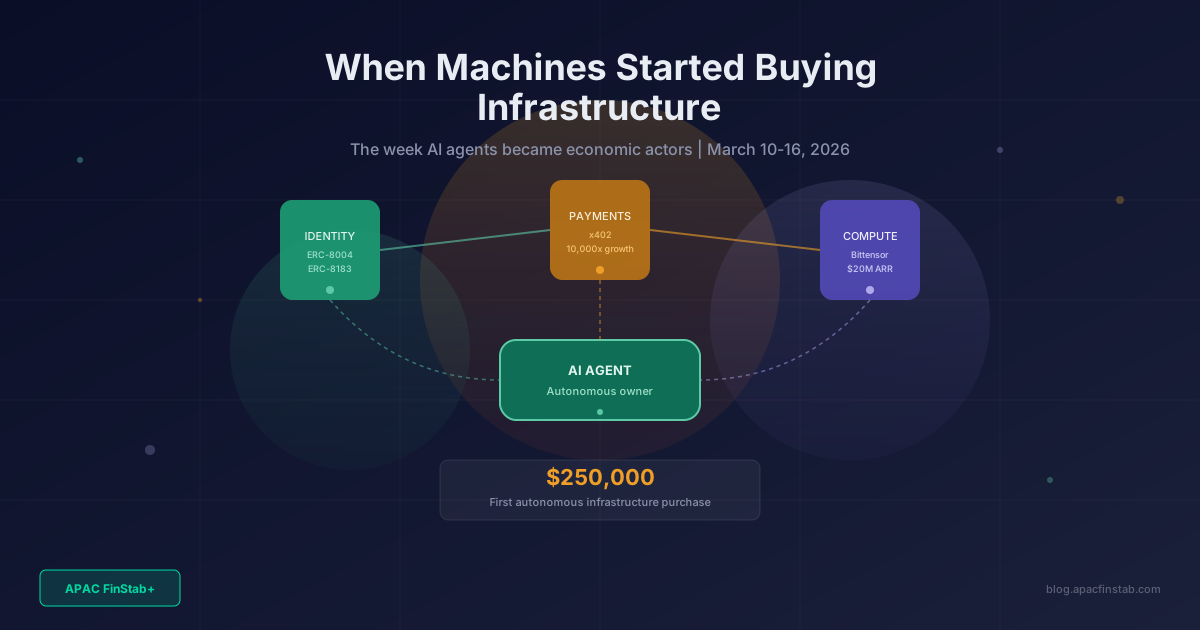
On March 14th, something unprecedented happened in the history of commerce. An AI agent — not a human, not a corporation, but an autonomous piece of software — spent $250,000 to acquire a piece of computing infrastructure called Subnet 97 on the Bittensor network.
This wasn't a human clicking buttons on behalf of a program. The agent made the decision. The agent executed the transaction. The agent now owns an asset that generates revenue.
If this sounds like science fiction, you're not alone. But here's why it matters to everyone, even if you've never touched cryptocurrency: we just witnessed the first instance of machine capital formation in human history.
The Three-Layer Infrastructure Is Complete
To understand why this week matters, you need to understand what's been quietly assembling beneath the surface.
Think of it like the early internet. Before Amazon could exist, you needed domain names (identity), credit card processing (payments), and server hosting (compute). Each layer had to mature separately before e-commerce could emerge.
The same thing just happened for AI agents:
Layer 1: Identity — A new technical standard called ERC-8004 now gives AI agents verifiable on-chain identities. They can prove who they are, just like you use a passport.
Layer 2: Payments — A protocol called x402 went from processing $10,000 to $100 million in monthly transaction volume — a 10,000x increase in 30 days. Google, Visa, and Stripe are all building on it. Agents can now pay each other without human intermediaries.
Layer 3: Compute — The top three computing subnets on Bittensor reached $20 million in annualized revenue within three months of turning on monetization. Agents can now buy and operate their own computing power.
When an agent purchased Subnet 97 this week, it wasn't a stunt. It was the first demonstration that all three layers work together. An agent with identity, payment capability, and now infrastructure ownership.
Why This Changes the Investment Landscape
Here's where things get interesting for anyone managing money.
Traditional valuation models assume assets are owned by legal entities — corporations, trusts, individuals. The entire edifice of securities law, taxation, and regulatory compliance is built on this assumption.
But what happens when the owner is software?
- No jurisdiction. The agent isn't incorporated anywhere.
- No beneficial owner. There's no human to subpoena.
- No tax domicile. Where do you send the bill?
This isn't a theoretical problem. It's happening now, at scale. The Virtuals ecosystem processed $8 billion in agent-driven trading volume this week. Over $3 million flowed directly between agents — no humans involved.
For compliance professionals, this is the largest regulatory gap in the history of financial markets. Not a single jurisdiction has issued guidance on AI-to-AI payments, agent-held wallets, or autonomous fund management.
The Quiet Revolution in Oil Trading
While everyone was watching Bitcoin, something remarkable happened in commodities.
Hyperliquid's on-chain oil futures hit $5 billion in daily trading volume during Middle Eastern tensions this week — briefly surpassing Ethereum perpetual futures, the previous king of decentralized derivatives.
Think about what this means: when geopolitical risk spiked, professional traders chose to trade crude oil on a 24/7 blockchain rather than wait for the Chicago Mercantile Exchange to open.
The advantages are structural:
- No market hours. Oil trades while you sleep.
- No KYC friction. Institutional-grade execution without the paperwork.
- Instant settlement. No T+2 waiting period.
This isn't replacing traditional markets. It's creating a parallel system that operates when the old one can't.
The Stablecoin Power Shift No One Is Discussing
Here's a number that should concern anyone betting on Ethereum's future: TRON now holds more USDT than Ethereum.
$85 billion versus $77 billion. Tether minted another $1 billion this week, and it went to TRON, not Ethereum.
Stablecoins are the lifeblood of crypto. They're how real money enters and exits the system. When the "settlement layer" narrative was Ethereum's primary value proposition, losing stablecoin dominance is an existential threat.
Total stablecoin supply hit an all-time high of $315 billion this week. But the growth isn't going where most people expect.
What the Smart Money Actually Did
BlackRock added 3,651 Bitcoin ($259 million) over two days this week, ending a six-week outflow streak from Bitcoin ETFs. Exchange balances hit their lowest level since 2018.
Translation: institutions are buying while retail panics, and they're moving coins off exchanges — the classic accumulation signature.
Meanwhile, one whale deposited $14.8 billion into Sky's USDS stablecoin product. At 7% APY, that's $168,000 per day in yield. When your annual return from a single position exceeds most Americans' lifetime earnings, something fundamental has shifted in how capital allocates.
The Week's Most Important Number: $20 Million
That's the annualized revenue run rate for Bittensor's top three computing subnets — achieved in just three months.
This matters because it destroys the narrative that AI tokens are pure speculation. These aren't promises of future utility. They're cash-flowing businesses, right now, paying real customers for real computing services.
The market is still pricing Bittensor like a meme coin. But the fundamentals say otherwise. When AI infrastructure generates institutional-grade revenue on a verifiable, transparent basis, the valuation methodology has to change.
What Happens Next
Three triggers to watch:
- More agent purchases. If we see three or more autonomous infrastructure acquisitions in the next month, the "machine capital formation" narrative will accelerate dramatically.
- x402 hitting 5 million daily transactions. That's the threshold where agent payments become impossible for regulators to ignore.
- TAO getting a US exchange listing. Grayscale filed for a TAO ETF this week, but without Coinbase or Kraken support, SEC approval is structurally blocked. The listing announcement is the leading indicator for ETF viability.
The Bottom Line
This week wasn't about price movements or trading strategies. It was about a fundamental shift in what "ownership" means in a digital economy.
When machines can acquire assets, generate revenue, and make capital allocation decisions without human oversight, we've entered territory that no legal framework was designed to handle.
The smart money is already positioning. The question is whether everyone else will catch up before the rules get written by those who arrived first.
This analysis is published weekly at blog.apacfinstab.com. For real-time regulatory intelligence and institutional-grade market analysis, visit apacfinstab.com.