When Bombs Fall in Tehran, Bitcoin Crashes in Tokyo: The Week Crypto Lost Its "Safe Haven" Story
Three missiles. Thirty minutes. Five billion dollars gone.
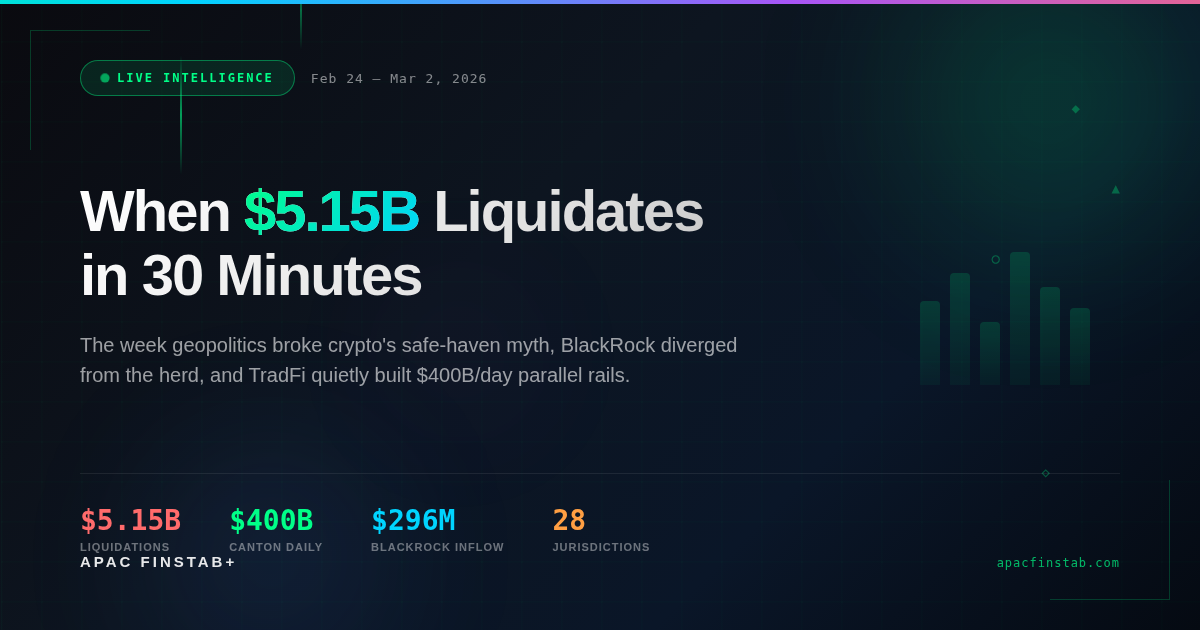
Last week, while most of us were asleep, Iran launched airstrikes against Israel. Within half an hour, $5.15 billion in crypto positions were liquidated. Bitcoin crashed from $68,000 to $63,000. The Fear & Greed Index—a measure of market sentiment—collapsed to 11, the second-lowest reading in three years.
For years, we've been told Bitcoin is "digital gold." A hedge against chaos. The asset you hold when the world burns.
Last week, the world burned. And Bitcoin burned with it.
This isn't just a trading story. It's the death of a narrative.
The New Reality: Crypto Is a Risk Asset, Not a Safe Haven
Let's be clear about what happened. When Iranian missiles flew, crypto didn't act like gold. It acted like a leveraged tech stock.
The numbers don't lie:
- Bitcoin-to-gold ratio hit an 11-year low
- Seven consecutive months of Bitcoin underperforming gold
- Futures markets showed 40:1 short-to-long ratio—the most bearish positioning in years
For institutional investors who allocated to crypto as "uncorrelated alpha," this is a fundamental problem. Their models assumed crypto would zig when traditional markets zagged. Instead, crypto amplified the panic.
If you're a hedge fund manager reading this: Your risk models need updating. Crypto is not a diversifier during geopolitical shocks. It's a multiplier.
The Real Story Nobody's Talking About: Wall Street Is Building Its Own Blockchain
While everyone was watching missiles and liquidations, something far more consequential happened quietly in the background.
Canton Network—a private blockchain run by DTCC and Goldman Sachs—is now processing $400 billion per day in tokenized treasury settlements.
Read that again. $400 billion. Per day.
That's more transaction volume than most public blockchains process in a year. And it's happening on a private network that you've probably never heard of.
Here's what this means: Traditional finance isn't "adopting crypto." They're building their own version—with privacy controls, compliance features, and institutional-grade settlement. The dream of "banks will eventually use Ethereum" may need serious reconsideration.
Canton handles $5.9 trillion in monthly repo volume. HSBC, BNP Paribas, and major global banks are validators. This isn't a pilot program. It's production infrastructure.
The implication is uncomfortable but important: The future might not be "TradFi comes to crypto." It might be "TradFi builds parallel rails and leaves public chains for retail."
The Divergence Signal: BlackRock Is Buying While Everyone Else Runs
Here's where it gets interesting.
Yes, Bitcoin ETFs recorded their fifth consecutive week of outflows. February saw $206 million leave the market. Headlines screamed about institutional abandonment.
But on March 1st, something curious happened: BlackRock's IBIT recorded $296 million in single-day inflows—the largest since the ETF converted from a trust.
This isn't contradiction. It's divergence.
Think about it: Grayscale holders who've been trapped since 2021 are finally escaping. Fidelity saw tactical redemptions during the crash. But BlackRock—the $10 trillion asset manager that doesn't make emotional decisions—was buying the dip.
The lesson: Not all institutional money is the same. Some are tourists exiting. Some are strategists building positions. Knowing the difference is worth billions.
Ethereum Foundation Makes a Historic Pivot
For years, the Ethereum Foundation maintained strict neutrality. They built infrastructure. They didn't pick winners in the application layer.
That changed last week.
The EF announced its first-ever dedicated DeFi team. They published six priorities for 2026: privacy by default, censorship resistance, decentralization advancement, security hardening, standards unification, and permissionless infrastructure support.
This matters for a simple reason: EF endorsement will become a form of institutional legitimacy.
Already we're seeing signals. Vitalik deposited 1,000 ETH into Railway, a privacy protocol using "Proof of Innocence" technology. That's not a random act. It's an endorsement.
For compliance teams at institutions: Track which protocols receive EF grants or collaboration. These will become the "blessed" DeFi protocols that pass institutional due diligence.
The Quantum Clock Is Ticking
Vitalik also dropped something that received far less attention than it deserved: a concrete roadmap for quantum-resistant cryptography.
The target: Implement EIP-8141 account abstraction by end of 2026, incorporating hash-based signatures and STARK aggregation into the consensus layer.
This isn't theoretical anymore. It's on a timeline.
Here's why this matters: Every protocol that can't demonstrate a quantum-resistance roadmap will face credibility challenges by 2027. Institutional allocators will start asking "What's your post-quantum plan?" the same way they now ask "What's your security audit?"
The protocols that prepared early will have a competitive advantage. The ones that didn't will scramble.
What Happens Next?
We're watching three things this week:
1. BlackRock flow persistence. If IBIT continues positive inflows for 3+ consecutive days, it's a major institutional sentiment signal. The big money is betting this crash was a buying opportunity.
2. March license decisions in Hong Kong. The stablecoin licensing window closes this month. Which issuers get approved will determine who operates in Asia's most important crypto hub.
3. Bitwise AI ETF trajectory. The first institutional vehicle covering FET, RENDER, and TAO has filed. If approved, it's the "BTC ETF moment" for AI-crypto convergence. Watch for SEC response timeline.
The Bottom Line
Last week reminded us that crypto isn't what many hoped it would be. It's not digital gold. It's not uncorrelated alpha. It's a high-beta risk asset that amplifies global chaos.
But last week also showed us the future that's quietly being built. Private institutional blockchains processing trillions. Strategic buyers accumulating during panic. Quantum-resistant infrastructure on concrete timelines.
The narrative changed. The smart money noticed.
Will you?
For real-time regulatory intelligence and weekly analysis, visit apacfinstab.com and subscribe to our dashboard updates at blog.apacfinstab.com.